
SAM.gov
SAM.gov Isn't the Only Place to Find Government Contracts
SAM.gov is the official source for federal opportunities. State, county, city, school district, and public authority contracts are published somewhere else entirely — here is where.
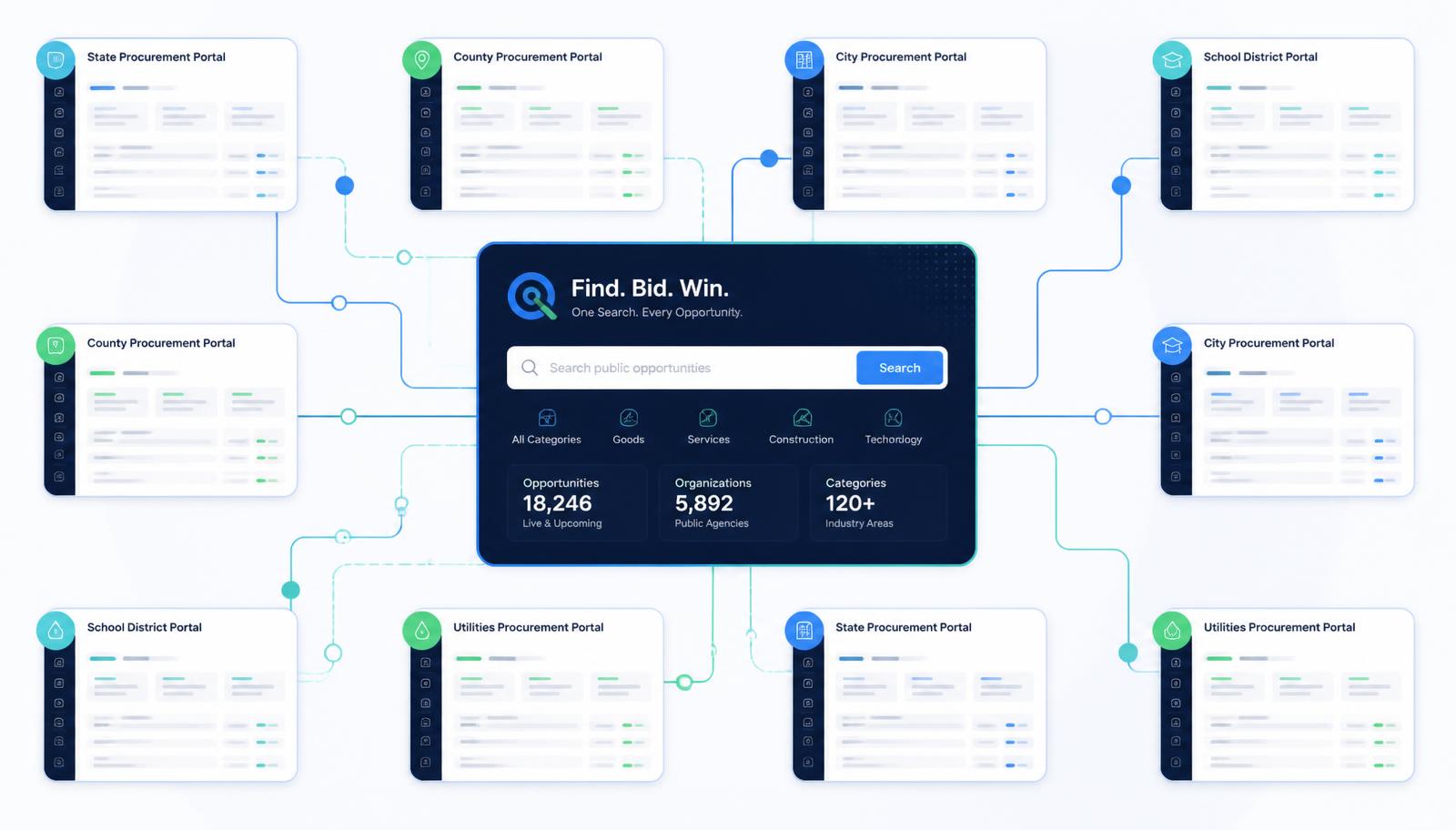
If you have started looking for government work, you have almost certainly been told to register on SAM.gov. That advice is correct. SAM.gov is the official U.S. government system for federal contract opportunities, and no business can receive a federal award without being registered there.
The problem is what happens next. Many businesses register, save a few searches, see little that fits, and conclude that government contracting is not for them. Usually the conclusion is wrong. They were looking at the federal marketplace only, while the majority of public agencies that could buy what they sell — cities, counties, school districts, universities, transit and housing authorities, utilities, special districts — publish somewhere else entirely.
This article explains what SAM.gov covers, what it does not, and where the rest of the public-sector marketplace actually posts its opportunities.
What is SAM.gov?
SAM.gov — the System for Award Management — is the official U.S. government website for federal entity registration and federal contract opportunities. It is operated by the federal government, it is free to use, and it serves two main functions:
- Entity registration. Businesses that want to do business with the federal government register there and receive a Unique Entity ID, along with recording their NAICS codes, size status, and representations and certifications.
- Opportunity publication. Federal contracting officers post solicitations and related notices there so that vendors can find and respond to them.
GovTasks is an independent software platform. It is not affiliated with, endorsed by, or operated by SAM.gov, the General Services Administration, or any government agency.
What types of opportunities are on SAM.gov?
SAM.gov carries the federal notice types a contractor works with day to day:
- Presolicitations and sources sought notices, used to gauge market interest before a formal solicitation
- Solicitations — RFPs, RFQs, and IFBs from federal agencies
- Combined synopsis/solicitations for commercial items
- Award notices, which show who won and often at what value
- Special notices, including industry day announcements
- Sale of surplus property and other government-specific notices
It also supports filtering by NAICS, set-aside type, agency, place of performance, and posting date — genuinely useful once your codes and geography are dialed in.
What SAM.gov does not cover
SAM.gov is a federal system, and it does exactly what it is designed to do. It is not a national index of all public-sector purchasing, because no such index exists.
The reason is structural. In the United States, procurement authority is decentralized. A state agency, a county government, a city, an independent school district, a public university system, a transit authority, and a municipal water utility are each their own buying entity with their own rules, thresholds, and publication practices. There is no legal requirement that any of them post to a single federal site, and almost none of them do.
So the opportunities missing from a SAM-only search are not obscure edge cases. They are the everyday contracts — the district's grounds maintenance rebid, the county's IT staffing contract, the housing authority's unit turnover work — that are often the best fit for a small business.
Where state government contracts are posted
Nearly every state operates a central procurement portal where statewide agencies post solicitations and vendors register. Names and systems differ by state, but the pattern is consistent: register as a vendor, select commodity or service categories, and receive notifications for matching solicitations.
Two things to know:
- Category selection matters more than keyword search on many state systems, because notifications are driven by the codes you picked at registration.
- Local participation varies. Some states allow or encourage cities, counties, and districts to post on the state portal; in other states those entities publish only on their own sites.
Where county government contracts are posted
Counties typically publish on a purchasing or procurement page on the county website, sometimes backed by a commercial e-procurement platform and sometimes as a plain list of PDFs. Counties buy heavily in facilities, public works, health and human services, corrections, technology, and professional services, and county contracts are often sized well for regional firms.
Where city government contracts are posted
Cities are the most fragmented layer and, for many small businesses, the most accessible. Larger cities usually run a vendor portal with registration and automated notices. Mid-size and smaller municipalities may post bids on a "Bids and RFPs" webpage, publish legal notices in a local newspaper, or email registered vendors directly. Local preference policies — extra evaluation credit for businesses based in the jurisdiction — are common at this level.
School district and university procurement opportunities
K-12 districts and public higher education institutions are substantial buyers that rarely appear in federal searches. Typical purchases include facilities and custodial services, grounds and athletic field maintenance, student transportation, food service, technology and software, security systems, tutoring and instructional services, professional development, and construction and renovation.
Districts usually post on their own site or through a regional education service agency. Universities generally run their own procurement portal, and many participate in purchasing cooperatives that let other public agencies buy from an already-competed contract — which makes a single cooperative award unusually valuable.
Transportation authority opportunities
Transit agencies, port authorities, airport authorities, and toll and highway authorities operate as independent entities with their own procurement offices. They buy vehicle maintenance, facility services, fare and signage systems, engineering and planning support, security, IT, and construction. Many receive federal funding, which means federal clauses can apply even though the solicitation is posted on the authority's own site rather than SAM.gov.
Housing authority opportunities
Public housing authorities contract for unit turnover and renovation, maintenance and repair trades, landscaping, pest control, security, resident services, and professional services such as accounting and IT. Authorities are typically local entities and post on their own websites, sometimes supplemented by regional listing services.
Utility and public authority contracts
Municipal and regional utilities — water, wastewater, stormwater, electric, gas — plus economic development corporations, convention and stadium authorities, and other quasi-governmental bodies all run procurements. These buyers need engineering, construction, equipment, chemicals, meters and instrumentation, IT and SCADA support, facility services, and professional services. They are easy to overlook precisely because they do not look like "government" in the way a city hall does.
Why searching government opportunities becomes complicated
Add up one federal system, fifty-odd state portals, thousands of counties and municipalities, roughly thirteen thousand school districts, hundreds of public colleges and universities, and thousands of authorities, utilities, and special districts, and the scale of the monitoring problem is obvious.
The practical friction compounds:
- Every portal has its own registration, login, and notification settings
- Category taxonomies differ — NAICS in one place, NIGP commodity codes in another, custom categories elsewhere
- Notice formats range from structured data to a scanned PDF
- Posting windows are short, and a response period can be two or three weeks
- Alerts are noisy, so businesses either drown in irrelevant email or turn notifications off
Very few small businesses have the hours to monitor even a dozen sources properly, which is why so much local work is bid by a handful of incumbents.
Why opportunity matching matters
Aggregation alone does not solve the problem. A feed of ten thousand opportunities is not more useful than five portals if you still have to read all of it.
What makes a large pool workable is matching against the specifics of your business:
- Capabilities — what you actually deliver, in the buyer's language
- Codes — NAICS and commodity categories, including near-neighbors
- Geography — where you can serve profitably, including response-time constraints
- Contract size — the range your capacity and bonding can support
- Certifications — set-aside and local preference eligibility
- Buyer type — the agency categories that repeatedly buy what you sell
- Timing — whether enough of the response window remains to submit well
Scoring on those factors turns "here is everything" into "here are the eleven worth reading this week." The scoring should also be explainable — you should be able to see which factors drove a score up or down, so you can trust it and correct your profile when it is wrong.
A better government opportunity search strategy
- Keep SAM.gov. Register, complete your representations, and save searches for your codes. Federal work is worth pursuing.
- Register on your state portal and select categories carefully, since those selections drive your notifications.
- Build a target buyer list of the twenty-five to fifty nearest agencies — cities, counties, districts, universities, authorities, utilities — and register with each one that allows it.
- Review past awards for those buyers to learn realistic contract sizes and when current contracts expire.
- Set a weekly review rhythm rather than checking sporadically when work is slow.
- Filter for fit before reading in depth, using scope, geography, size, deadline, and requirements as a first pass.
- Use a tool to aggregate and rank once manual monitoring exceeds the time you can give it.
How GovTasks approaches the problem
GovTasks is built around a simple sequence: one business profile → opportunities from across the public sector → ranked, explainable matches → an organized pursuit.
Today that means you describe your business once — capabilities, codes, geography, size, certifications — and GovTasks ingests opportunities from its connected sources, normalizes and deduplicates them, and scores each one against your profile with a breakdown of the factors behind the score. When you decide to pursue an opportunity, it becomes a structured pursuit with requirements, tasks, owners, and deadlines.
The broader vision is wide state, local, and institutional coverage across the public-sector landscape described above. Sources are being added progressively, and the data coverage page and data sources page reflect what is connected at any given time. We would rather tell you exactly what is integrated than imply coverage that does not exist yet.
Frequently asked questions
Is SAM.gov free?
Yes. Registration and searching for federal contract opportunities on SAM.gov are free. Third-party services may charge to help with registration, but the official system does not charge for access.
Does SAM.gov include state contracts?
No. SAM.gov publishes federal contract opportunities. State agency solicitations are posted on state procurement portals, not on SAM.gov, though a state project funded by a federal grant may reference federal requirements.
Does SAM.gov include city contracts?
No. Municipal solicitations are published by the city itself — usually on its purchasing page or vendor portal — and are not posted to SAM.gov.
Where are local government bids posted?
On the buying entity's own website or vendor portal, on a regional or commercial e-procurement platform the entity subscribes to, sometimes on the state portal where that is permitted, and in local legal notices. Registering directly with each agency you want to work with is the most reliable way to get notified.
Are school district contracts listed on SAM.gov?
Generally no. K-12 districts publish on their own sites, through regional education service agencies, or through purchasing cooperatives. They are independent public buyers, not federal agencies.
How can I search multiple government procurement sources?
Either build a routine — a target list of agencies, vendor registrations with each, and a scheduled weekly review — or use a platform that aggregates sources and ranks results against your business profile. The routine is free and time-intensive; a platform trades cost for coverage and time. Either way, the goal is the same: see the opportunities that fit before the response window closes.
Find Government Opportunities Built for Your Business
Government opportunities exist across thousands of public agencies — but finding the right ones shouldn't require searching dozens of procurement websites. Tell GovTasks what your business does and discover opportunities matched to your capabilities.
GovTasks Editorial Team
The GovTasks Editorial Team creates practical resources to help small businesses discover, understand, and pursue government contracting opportunities across the public sector.
- SAM.gov alternatives
- state government bids
- local government bids
- school district bids
- government procurement websites
Government Contract Opportunities & Insights
Get practical government contracting strategies and GovTasks updates. Coming soon — create a free account and you'll be the first to hear.
Create a free GovTasks accountContinue Learning
SAM.gov Registration: A Step-by-Step Guide for Small Businesses
SAM.gov registration is free, mandatory for federal contracts, and easier to get right the first time. Here is exactly what you need, what to expect, and the mistakes that delay approval.
9 min read
Read Article
How to Bid on Government Contracts: A Practical Guide for Small Businesses
Most losing bids fail on completeness, not price. A ten-step process for reading a solicitation, making a bid/no-bid call, and submitting a compliant response on time.
11 min read
Read Article
How to Find Government Contracts for Small Businesses: A Step-by-Step Guide
Government agencies buy janitorial services, IT, staffing, and hundreds of other everyday services. Here is where those opportunities are published and how to tell a realistic one from a long shot.
12 min read
Read Article