
Bidding & Proposals
How to Bid on Government Contracts: A Practical Guide for Small Businesses
Most losing bids fail on completeness, not price. A ten-step process for reading a solicitation, making a bid/no-bid call, and submitting a compliant response on time.
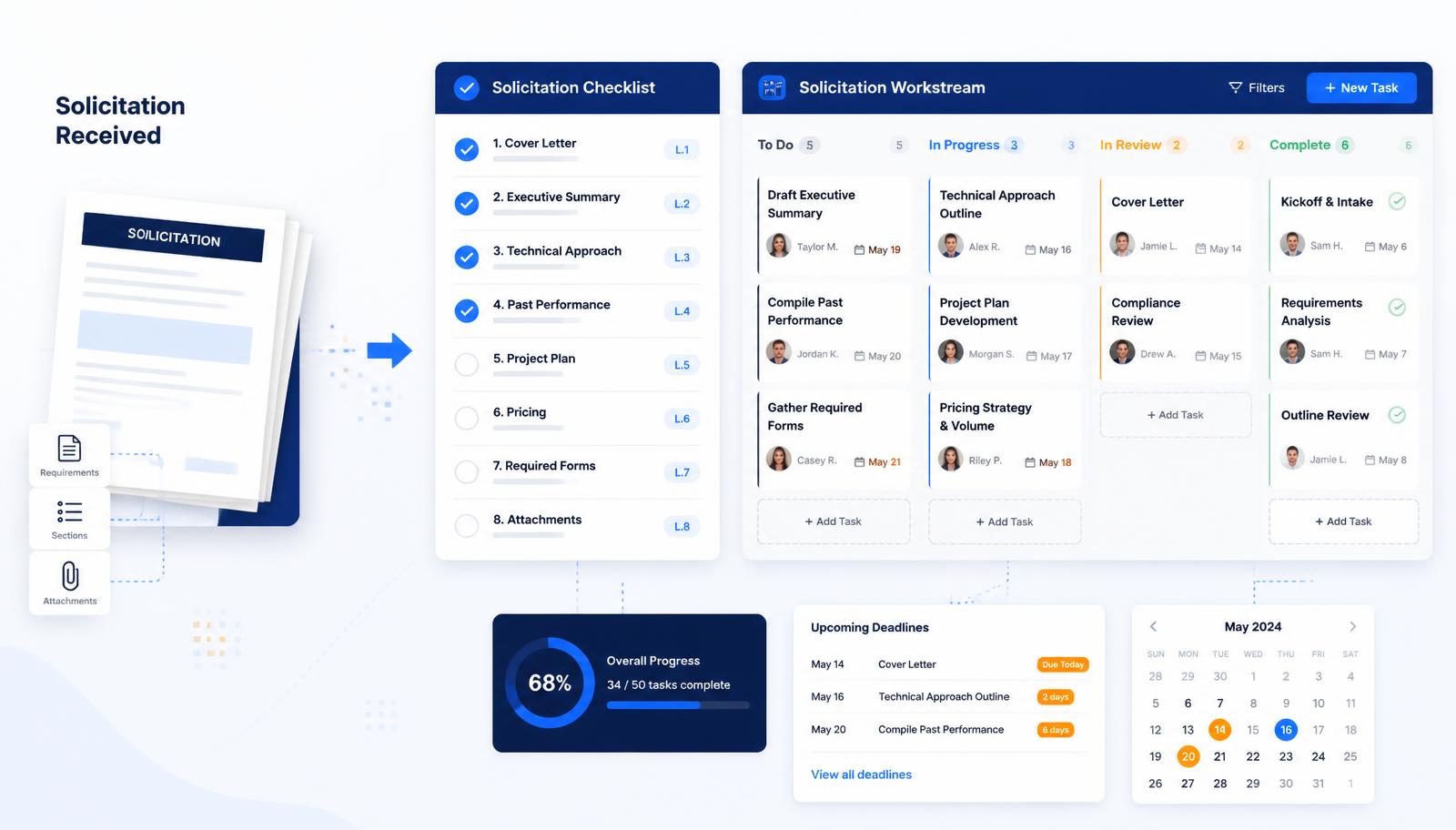
Most losing government bids are not lost on price or technical merit. They are lost on completeness — a missing form, an unsigned certification, a page limit ignored, a submission uploaded eleven minutes late. Public buyers evaluate against published rules, and a response that fails those rules can be set aside before anyone reads the substance.
That is good news for a disciplined small business. Bidding well is largely a process problem, and process is learnable. Here is how the government bidding process works and how to run a competitive response without a proposal department.
How government bidding works
The pattern is broadly consistent across federal, state, and local buyers:
- The agency identifies a need and defines the scope, budget, and evaluation approach.
- A solicitation is published with the statement of work, instructions to bidders, evaluation criteria, required forms, and a deadline.
- A question period opens. Vendors submit written questions; the agency answers publicly, usually as an amendment that becomes part of the solicitation.
- Vendors submit responses through a portal, by email, or as sealed physical copies, exactly as instructed.
- The agency checks responsiveness — did the submission arrive on time and include everything required?
- Responsive bids are evaluated against the published criteria: lowest price for a sealed bid, or a scored combination of technical factors and price for a proposal.
- The agency may request clarifications, hold interviews, or negotiate with a shortlist, depending on the method used.
- An award is made and announced, often with a protest window and, at some agencies, a debrief for unsuccessful bidders.
Timelines vary widely. A small local quote might close in ten days; a large federal or state procurement can run months from posting to award.
Common types of government solicitations
You do not need to master procurement law, but you do need to recognize what you are looking at, because the document type tells you how you will be evaluated.
- RFP (Request for Proposal) — asks how you would meet a need. Evaluated on multiple factors: approach, experience, staffing, and price. Best value, not necessarily lowest price.
- RFQ (Request for Quote) — asks for pricing on a defined item or service. Usually simpler and price-driven, common for smaller purchases.
- IFB / ITB (Invitation for Bid / Invitation to Bid) — a sealed-bid process for a tightly specified requirement, typically awarded to the lowest responsive, responsible bidder. Construction and commodities often use this.
- RFI (Request for Information) — market research. No award results, but responding puts you on the agency's radar and can shape the eventual scope.
- Sources sought — the federal equivalent of market research, often used to decide whether to set an award aside for small business. Responding matters more than most vendors realize.
- Simplified acquisition / small purchase — streamlined procedures for purchases under a dollar threshold, with lighter paperwork and shorter timelines. A common entry point.
Terminology drifts between jurisdictions; when in doubt, read the instructions section rather than trusting the label.
Step 1: Read the entire solicitation
Read all of it, including attachments and amendments, before you decide anything. Pay particular attention to the instructions to bidders, the evaluation criteria, the submission format, and the required forms list.
As you read, mark three things: what is required, what is scored, and what is unclear. Anything unclear becomes a written question before the question deadline — that deadline usually falls well before the submission date.
Step 2: Determine whether you meet the requirements
Check the hard gates first, because failing one makes everything else irrelevant:
- Registration and licensing in the right jurisdiction
- Required certifications or set-aside status
- Insurance types and coverage limits
- Bonding capacity, where required
- Minimum years in business or number of comparable projects
- Mandatory pre-bid conference or site visit attendance
- Geographic or response-time constraints
If you fail a hard gate, consider teaming or subcontracting instead of submitting a response that cannot be accepted.
Step 3: Decide whether the opportunity is worth pursuing
This is the bid/no-bid decision, and it deserves a deliberate few minutes rather than enthusiasm. Weigh:
- How closely the scope matches your core work
- Whether the contract value justifies the response effort
- How much of the response window remains
- Whether an incumbent exists and how long they have held the work
- Whether you can price it profitably at realistic labor and material costs
- What else your team is committed to over the same period
Saying no to three marginal opportunities so you can respond thoroughly to one strong one is usually the higher-return decision.
Step 4: Identify every required document
Build the list directly from the solicitation, not from memory. Depending on the procurement, it may include:
- Pricing sheets in the exact format provided
- Technical or approach narrative
- Company information and organizational details
- References and past performance write-ups
- Certificates of insurance, or a letter of intent to insure
- Licenses and registrations
- Certifications and set-aside documentation
- Representations and certifications forms
- Signed addenda acknowledgments
- Bid bond or surety documentation
- Subcontractor or teaming disclosures
- Key personnel resumes
- Signature pages, sometimes notarized
Exact requirements vary by solicitation — this is a prompt list, not a universal checklist. The authoritative list is always the one in the document in front of you.
Step 5: Build a government bid checklist
Convert every requirement into a discrete, checkable line item. If the solicitation says responses must be submitted in two separately uploaded volumes with a fifteen-page technical limit and 12-point font, those are three checklist items, not a footnote.
A good checklist mirrors the solicitation's own structure and evaluation criteria, so a reviewer can walk the document and your response side by side. Many agencies publish a submission checklist themselves — use theirs and add to it.
Step 6: Assign owners and deadlines
Every line item needs a name and a date. Give externally dependent items — insurance certificates, subcontractor quotes, reference confirmations, notarizations, bonding — the earliest dates, because they are the most common cause of a missed deadline.
Schedule backward from the submission date and build in real slack:
- Draft complete: five to seven days before submission
- Internal review: three to four days before
- Compliance check: two days before
- Final assembly and upload: at least one full business day before
For a team, shared ownership and visible due dates are the difference between a coordinated response and a frantic final evening. This is exactly the structure a GovTasks pursuit creates automatically.
Step 7: Prepare your proposal
Write to the evaluation criteria, in the order the solicitation presents them. Evaluators score sections against a rubric; making them hunt for your answer costs points.
Practical guidance:
- Answer the question asked, then support it with specifics — staffing, schedule, method, quality control
- Use the agency's terminology, not your internal shorthand
- Replace adjectives with evidence: crew sizes, response times, comparable project scope, measurable outcomes
- Make past performance relevant, recent, and similar in size and scope
- Price from real costs, including compliance, insurance, and reporting overhead
- Keep formatting clean and follow page limits exactly
Step 8: Review compliance before submission
Do a dedicated compliance pass, ideally by someone who did not write the response. Walk the solicitation line by line and confirm each requirement is met, each form is signed and dated, every amendment is acknowledged, page and format limits are respected, and file names and volume structure follow the instructions.
Fix substance issues at the draft stage. The compliance pass is for completeness.
Step 9: Submit before the deadline
Submit at least a day early. Portals slow down near closing time, large files fail to upload, accounts lock, and multi-factor prompts arrive at the worst moment. Most agencies cannot accept a late submission regardless of the reason.
Confirm receipt. Save the confirmation number, timestamp, or email. If the submission is physical, verify the delivery instructions — the receiving office and the mailing address are frequently different, and delivery is judged by when it reached the specified office.
Step 10: Track the opportunity after submission
The work is not finished at upload. Watch for clarification requests and answer them quickly. Note the anticipated award date and follow up appropriately. When an award is announced, review it: who won, at what price, and how your response compared.
Request a debrief where one is offered. A debrief is the cheapest competitive intelligence available, and losing bidders who ask for one tend to score better next time. Keep your response archived and reusable — the second bid to the same agency should take a fraction of the time.
What makes a government bid competitive?
Evaluation methods differ by agency and solicitation type, so treat these as general strengths rather than a universal formula:
- Compliance — every requirement met, exactly as instructed
- Responsiveness — answers the stated need rather than describing your company generally
- Capability — credible staffing, equipment, and capacity for the work described
- Past performance — relevant, verifiable, and comparable in size and scope
- Price and value — realistic pricing you can perform on, with clear justification
- Understanding of requirements — evidence you grasp the site, the constraints, and the risks
- Professionalism — organized, readable, error-free documents
Common government bidding mistakes
- Starting the response with a week left
- Skimming the solicitation and missing an attachment or amendment
- Missing the written question deadline and guessing at ambiguous scope
- Skipping a mandatory pre-bid conference or site visit
- Submitting a generic capability statement instead of answering the criteria
- Ignoring page limits, format rules, or file naming instructions
- Underpricing to win and then struggling to perform
- Failing to acknowledge amendments
- Uploading in the final minutes
- Not requesting a debrief after a loss
How GovTasks can help organize the process
GovTasks is designed around the moment after you decide an opportunity is worth pursuing. Instead of a solicitation sitting in a download folder, it becomes a structured pursuit: requirements extracted into a checklist, tasks generated across the phases of a response, owners assigned, and deadlines scheduled backward from the submission date so the externally dependent items start first.
Before that, GovTasks helps you get to a good decision faster — opportunities matched to your business profile with an explainable fit score, so you spend your reading time on realistic pursuits. You can see the full workflow on the how it works page, compare plans on the pricing page, or start with the readiness assessment.
GovTasks is an independent software platform, not a government agency, and it does not submit bids on your behalf or influence any award decision.
Frequently asked questions
Is it hard to bid on government contracts?
The first bid is the hardest, mostly because of unfamiliar forms and registration steps. The process itself is rule-based and repeatable: read the solicitation, confirm you meet the requirements, assemble every required document, and submit on time. Businesses that build a reusable process find each subsequent bid considerably faster.
Do small businesses need government contracting experience?
No. Many solicitations require relevant experience, but that experience can be commercial work of similar scope. Starting with smaller local contracts, subcontracting to an established prime, or responding to simplified acquisitions are all common ways to build a public-sector past performance record.
How long does government bidding take?
Response windows commonly run two to six weeks from posting to deadline, though small quotes can close in a week or two. Award timelines vary widely — a few weeks for simple purchases, several months for complex evaluations.
What documents are required to bid?
It depends on the solicitation, but responses commonly include pricing in a required format, a technical or approach narrative, company information, references or past performance, insurance certificates, licenses, signed certifications and representations, acknowledged amendments, and sometimes bonding. The solicitation's own checklist is authoritative.
Can new businesses bid on government contracts?
Yes. Some solicitations set minimum years in business or comparable project counts, but many do not. New businesses often start with smaller local opportunities, simplified acquisitions, or subcontracting roles where the prime carries the past performance requirement.
What happens after a bid is submitted?
The agency verifies responsiveness, evaluates against the published criteria, may request clarifications or hold interviews, and then announces an award — frequently with a protest period and, at many agencies, an opportunity for unsuccessful bidders to request a debrief.
What is a bid/no-bid decision?
It is the deliberate choice about whether to pursue an opportunity, based on scope fit, contract value, time remaining, competition, your capacity, and whether you can price the work profitably. Making the decision explicitly protects the time you need to submit strong responses on the opportunities you do pursue.
Find Government Opportunities Built for Your Business
Government opportunities exist across thousands of public agencies — but finding the right ones shouldn't require searching dozens of procurement websites. Tell GovTasks what your business does and discover opportunities matched to your capabilities.
GovTasks Editorial Team
The GovTasks Editorial Team creates practical resources to help small businesses discover, understand, and pursue government contracting opportunities across the public sector.
- how to bid on government contracts
- government bidding process
- government RFP
- government solicitation
- government proposal
Government Contract Opportunities & Insights
Get practical government contracting strategies and GovTasks updates. Coming soon — create a free account and you'll be the first to hear.
Create a free GovTasks accountContinue Learning

SAM.gov Registration: A Step-by-Step Guide for Small Businesses
SAM.gov registration is free, mandatory for federal contracts, and easier to get right the first time. Here is exactly what you need, what to expect, and the mistakes that delay approval.
9 min read
Read Article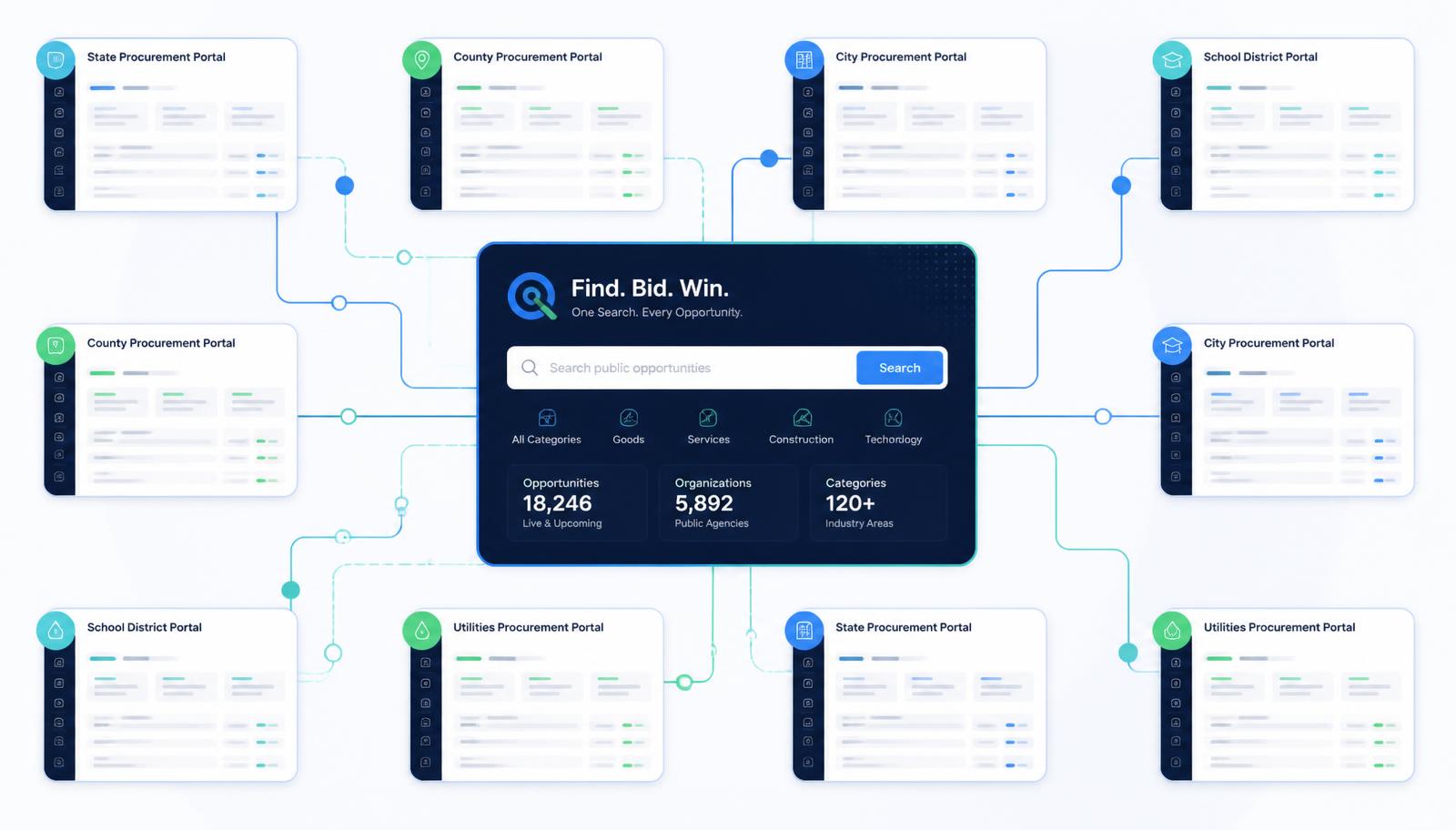
SAM.gov Isn't the Only Place to Find Government Contracts
SAM.gov is the official source for federal opportunities. State, county, city, school district, and public authority contracts are published somewhere else entirely — here is where.
9 min read
Read Article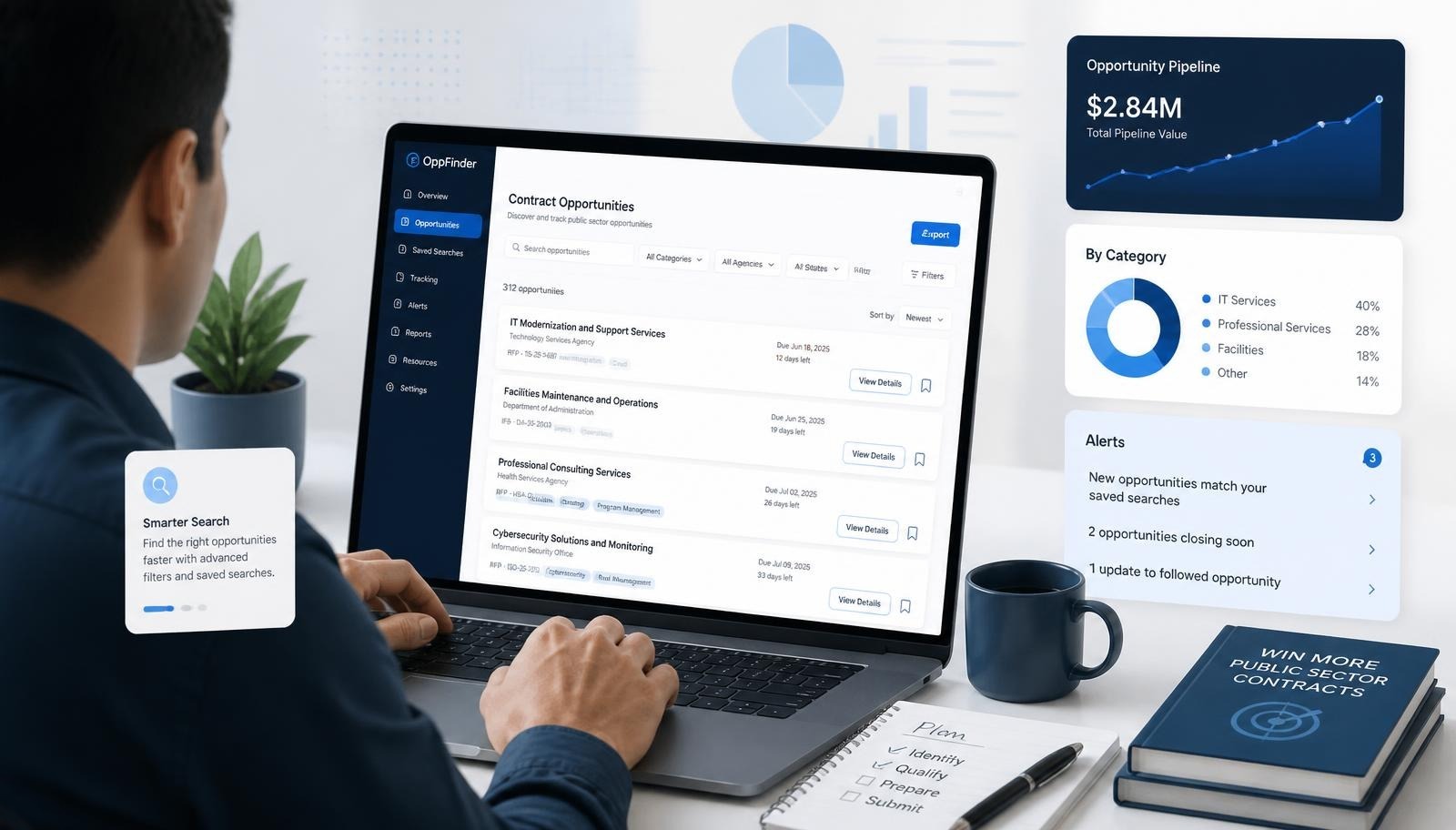
How to Find Government Contracts for Small Businesses: A Step-by-Step Guide
Government agencies buy janitorial services, IT, staffing, and hundreds of other everyday services. Here is where those opportunities are published and how to tell a realistic one from a long shot.
12 min read
Read Article