
Finding Opportunities
How to Find Government Contracts for Small Businesses: A Step-by-Step Guide
Government agencies buy janitorial services, IT, staffing, and hundreds of other everyday services. Here is where those opportunities are published and how to tell a realistic one from a long shot.
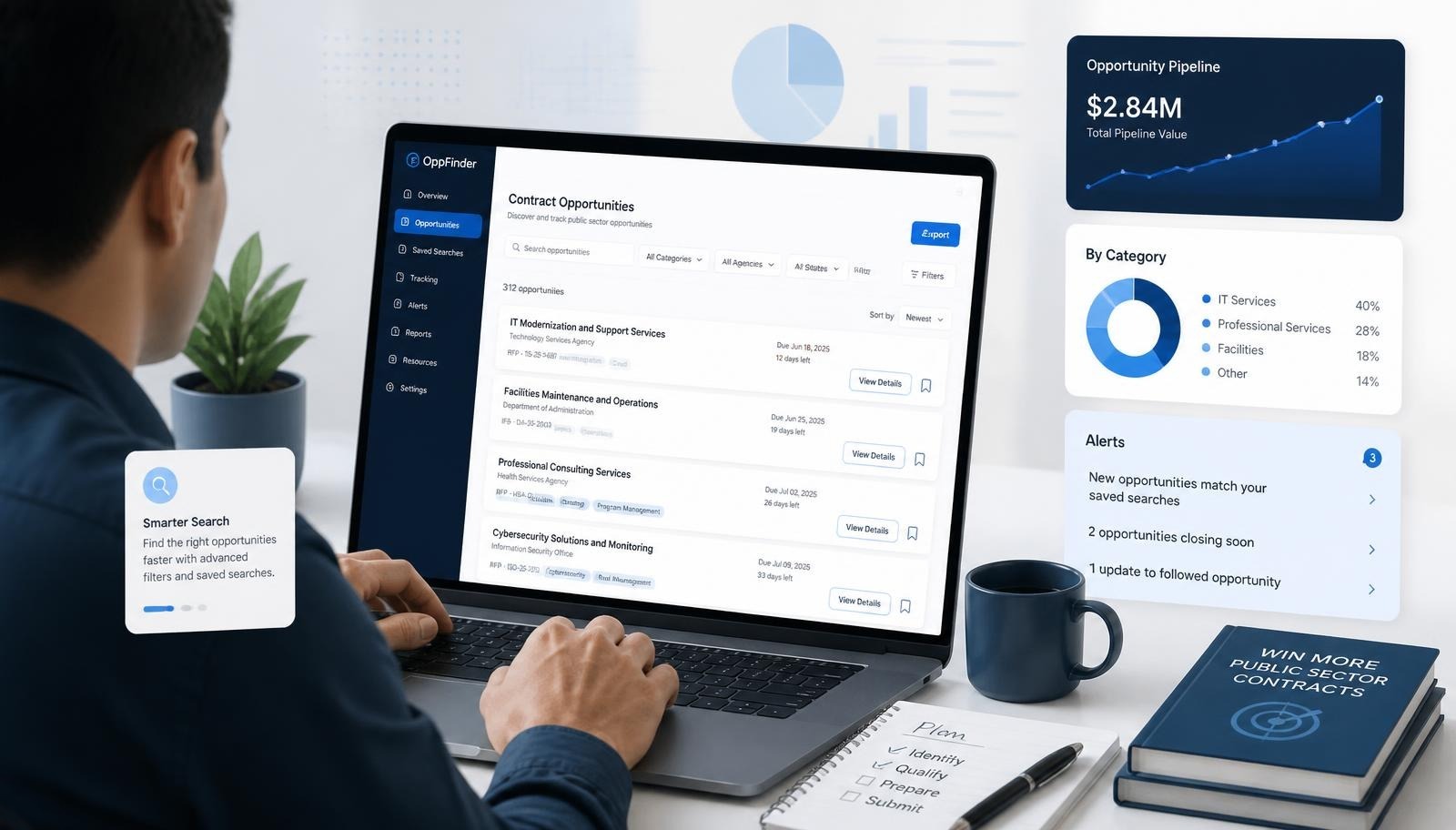
Government agencies buy almost everything a private company buys — cleaning, software, staffing, food, training, repairs — and they publish most of those purchases publicly before awarding them. That publishing requirement is the opening for small businesses. You do not need a lobbyist or an inside connection to see what is being bought. You need to know where purchases are posted, how to read them, and how to tell a realistic opportunity apart from a long shot.
This guide walks through how government purchasing actually works, where opportunities are published, and a practical seven-step process for finding contracts your business can realistically compete for.
What is a government contract?
A government contract is a binding agreement in which a public agency pays a business to deliver goods or services. Most agencies are required to buy competitively above certain dollar thresholds, which means they publish a solicitation, accept responses for a set period, evaluate them against stated criteria, and award the work.
Two ideas surprise most first-time contractors:
- Government buys ordinary things. Construction and defense systems get the headlines, but the everyday spend is routine commercial work: janitorial services, landscaping and grounds maintenance, IT support, cybersecurity, temporary staffing, consulting, transportation and hauling, marketing and outreach, printing, training, HVAC, electrical work, facility maintenance, food services, office supplies, medical supplies, software licenses, and professional services of nearly every kind.
- Most purchases are not enormous. Agencies buy in many small increments. A school district repainting three buildings and a county replacing its scheduling software are both contract opportunities, and both are sized for a small business.
If your company already sells to businesses in your region, there is a reasonable chance a public agency near you buys the same thing.
What types of government agencies buy from small businesses?
This is the part most guides skip, and it is the single biggest reason businesses conclude "there is nothing for me." They looked in one place. Public-sector buyers include:
- Federal agencies — cabinet departments, independent agencies, and their regional offices
- State governments — statewide agencies plus individual departments with their own buying authority
- Counties — public works, health, human services, sheriff and corrections, facilities
- Cities and towns — the largest source of small, local, recurring service contracts
- School districts — facilities, transportation, food service, technology, tutoring, professional development
- Public universities and community colleges — research support, facilities, IT, events, marketing
- Transportation authorities — transit systems, ports, airports, toll and highway authorities
- Housing authorities — maintenance, renovation, resident services, security
- Utilities — municipal water, electric, wastewater, and stormwater systems
- Public hospitals and health systems — supplies, clinical staffing, facilities, IT
- Special districts — fire, parks, library, irrigation, flood control, and similar single-purpose districts
- Public authorities and quasi-governmental entities — economic development corporations, convention centers, stadium authorities
- Military installations — base operations and support contracts, often with local scope
Each of these is a distinct buyer with its own procurement office, its own rules, and often its own website. That fragmentation is inconvenient, but it is also why competition on a county or district contract is frequently far lighter than on a comparable federal one.
Where can small businesses find government contracts?
There is no single national database of every public-sector opportunity. There are three broad layers:
Federal: SAM.gov. SAM.gov is the official U.S. government system for federal contract opportunities and for entity registration. Any business that wants to receive a federal award registers there and gets a Unique Entity ID. Federal solicitations above the micro-purchase level are generally posted there. It is authoritative, free, and the right starting point for federal work. (GovTasks is an independent software platform and is not affiliated with SAM.gov or any government agency.)
State: statewide procurement portals. Nearly every state runs a central bid system where statewide agencies post solicitations, and many states also let local entities post there voluntarily. Coverage and terminology vary from state to state.
Local and institutional: thousands of individual sites. Cities, counties, districts, universities, authorities, and utilities each publish somewhere — a vendor portal, a "Bids and RFPs" page, a purchasing department newsletter, or a regional cooperative. Some use commercial procurement platforms; some post a PDF on a webpage.
The practical consequence: a business that only monitors one federal database sees a narrow slice of what it could bid on, and a business that only checks its own city's page misses the county, the district, the transit authority, and the university one town over.
Step 1: Understand what your business can sell to government
Agencies do not buy "your company." They buy defined scopes of work. Start by translating what you do into the language a buyer would use in a solicitation title.
Write out, for each service line:
- What you deliver, in plain terms a non-expert can evaluate
- The size and complexity you can handle without straining
- The geography you can serve profitably
- Comparable work you have already done, with dates, scope, and outcomes
- Licenses, insurance limits, bonding capacity, and certifications you hold
That last group matters more than new contractors expect. A well-priced bid from a firm that cannot produce a required certificate of insurance is not a competitive bid.
Step 2: Identify relevant NAICS codes and procurement categories
NAICS codes are the standard numeric classification the federal government uses to describe industries — 561720 is janitorial services, 541512 is computer systems design. Agencies attach one to a solicitation to signal what kind of vendor they want, and small-business size standards are defined by code.
Practical guidance:
- Find the two to five codes that genuinely describe your primary revenue, not the twenty that touch it.
- Note the size standard for each one, so you know where you count as small.
- Learn the parallel vocabularies. State and local buyers often use NIGP commodity codes or their own category lists instead of NAICS, so the same service may be filed as "Custodial Services" in one system and 561720 in another.
Searching by code alone is a mistake — plenty of relevant solicitations are coded imperfectly — but code plus keyword plus geography is a strong filter.
Step 3: Identify the agencies most likely to buy your services
Buyer targeting beats broad searching. Ask which agencies have a standing, recurring need for what you sell:
- A commercial cleaning company should be watching school districts, county facilities departments, transit agencies, and housing authorities.
- An IT services firm should be watching city IT departments, community colleges, public health agencies, and utilities.
- A staffing firm should be watching public hospitals, human services departments, and universities.
Most agencies also publish past award data or meeting minutes showing what they bought and from whom. Reviewing a year of awards tells you the realistic contract size, the incumbent, and roughly when the work will be rebid.
Step 4: Search for relevant opportunities
Use several angles rather than one:
- Keyword — the terms buyers use ("custodial," "grounds maintenance," "managed IT services"), including synonyms
- NAICS or commodity code — your two to five core codes
- Geography — a radius you can actually serve, plus statewide where delivery is remote
- Agency — your target buyer list, checked on a schedule
- Category — the buyer's own service taxonomy, which often surfaces items keywords miss
Then make it repeatable. Pick a day of the week, work the list, and log what you found. Consistency, not cleverness, is what produces a pipeline.
Step 5: Determine whether an opportunity is actually a good fit
Finding opportunities and finding good-fit opportunities are different skills. Bidding on everything burns the time you need to bid well on the right things. Score each opportunity against:
- Scope — is the work you do the core of the requirement, or a small piece of a larger one?
- Geography — can you serve the site profitably, including travel and response-time requirements?
- Contract size — is it large enough to be worth the effort and small enough that you can perform it?
- Deadline — is there enough time left to assemble a complete, compliant response?
- Certifications — does it require a set-aside status, license, or registration you hold?
- Experience requirements — do the stated minimums (years in business, number of similar projects) match your record?
- Bonding and insurance — can you meet the required limits, and at what cost?
- Past performance — can you supply references for comparable public or private work?
- Mandatory meetings — is there a required pre-bid conference or site visit, and can you attend?
- Solicitation requirements — how many forms, attachments, and formats are involved?
A disciplined no is a productive outcome. It returns hours to the two or three pursuits where you have a real chance.
Step 6: Create a pursuit plan
Once you decide to bid, stop treating the solicitation as a document and start treating it as a project. Read it once for understanding, then again with a highlighter, converting every requirement into a line item:
- List every deliverable, form, certification, and attachment the solicitation requires.
- Turn each one into a task with a named owner.
- Schedule the tasks backward from the submission deadline, with internal due dates several days early.
- Separate the tasks that depend on other people — references, insurance certificates, subcontractor letters, notarized forms — and start those first, because they are what causes late submissions.
- Build in a final compliance review against the solicitation's own checklist.
This is the discipline that separates businesses that submit consistently from businesses that intend to. It is also the philosophy GovTasks is built around: an opportunity is not useful until it becomes an organized set of tasks with dates and owners.
Step 7: Submit and build your government contracting pipeline
Submit early. Portals get slow near deadlines, uploads fail, and most agencies have no discretion to accept a late response.
Then keep going. Public-sector sales cycles are long and results compound: debriefs teach you how you were scored, near-misses build relationships with buyers, and every completed response becomes reusable content — company information, technical narratives, past performance write-ups, and standard forms — that makes the next bid faster. Businesses that treat contracting as a quarterly experiment rarely see results. Businesses that submit steadily for a year usually do.
Federal vs. state vs. local government contracts
| Federal | State | Local (city, county, district) | |
|---|---|---|---|
| Where posted | SAM.gov | Statewide procurement portals | Individual agency sites, regional portals, cooperatives |
| Registration | Unique Entity ID via SAM.gov | State vendor registration | Per-agency vendor registration, often free |
| Typical size | Larger, often multi-year | Mixed | Frequently smaller and recurring |
| Competition | Broad, often national | Regional | Often local, sometimes very light |
| Rules | Uniform federal regulations | State-specific | Varies by jurisdiction |
| Set-asides | Formal federal programs | Varies by state | Local preference programs are common |
| Best for | Firms ready for heavier compliance | Firms serving a whole state | Firms with a defined service radius |
None of these is a better tier than the others. Local work is usually the fastest path to a first award; federal work rewards firms that invest in compliance infrastructure.
Common mistakes small businesses make
- Searching only SAM.gov. It is essential for federal work and silent on most city, county, district, and authority purchasing.
- Bidding on everything. Volume without fit produces losses and exhaustion.
- Starting too close to the deadline. Insurance certificates and references cannot be produced overnight.
- Not reading the whole solicitation. Requirements hide in attachments and amendments, and a missed form can make a strong bid non-responsive.
- Ignoring local opportunities. The nearest school district may be an easier first customer than any federal agency.
- Writing weak capability descriptions. Vague self-description makes both buyers and matching tools unable to place you.
- Failing to track deadlines. Pre-bid conferences, question deadlines, and submission times are separate dates.
- Not building a repeatable process. Rebuilding a response from scratch each time caps how many bids you can make.
How GovTasks helps
GovTasks is an independent software platform — not a government agency and not affiliated with one — built to make the discover → understand → organize → pursue path workable for a small team.
You create one business profile describing what you do, where you work, your codes, and your certifications. GovTasks brings opportunities in from connected public-sector sources, ranks them against that profile with an explainable fit score, and shows you why each one scored the way it did. When you decide to pursue something, GovTasks turns the solicitation into a structured pursuit with requirements, tasks, owners, and deadlines scheduled backward from the due date.
Source coverage is expanding over time; the platform's data sources page lists what is connected today. You can see the current picture on the data coverage page or start with the government contract readiness assessment.
Frequently asked questions
Can a small business get government contracts?
Yes. Public agencies buy routine goods and services continuously, many purchases are small, and federal and many state and local programs include set-asides or preferences for small, minority-owned, women-owned, veteran-owned, and locally based businesses. The practical requirements are registration, the ability to meet insurance and licensing terms, and a complete, on-time response.
Where do I find government contracts?
Federal opportunities are posted on SAM.gov. State opportunities are posted on statewide procurement portals. Local opportunities — cities, counties, school districts, universities, transit and housing authorities, utilities, and special districts — are posted across thousands of individual sites and regional portals, which is why most businesses need either a routine for checking their target agencies or a tool that aggregates them.
Is SAM.gov the only place to find government contracts?
No. SAM.gov is the official source for federal contract opportunities, and it does that job well. It is not a comprehensive index of state, county, city, school district, or public authority purchasing, which is where a large share of small-business-sized work lives.
Do I need an LLC to bid on government contracts?
Not necessarily. Sole proprietors can register and bid, though many businesses form an LLC or corporation for liability and banking reasons. What matters more is that your legal name, tax identification, registrations, and insurance are consistent everywhere you submit them.
How do local government contracts work?
A city, county, or district posts a solicitation, sometimes requires vendor registration or a pre-bid meeting, accepts responses through a portal or by sealed delivery, evaluates against published criteria, and awards — often with a public board or council vote. Timelines are usually shorter than federal ones, and local preference programs may apply.
What is an RFP?
A Request for Proposal is a solicitation that asks vendors to propose how they would meet a stated need, and it is evaluated on multiple factors — technical approach, experience, staffing, and price — rather than price alone. It differs from an Invitation for Bid, which is generally awarded to the lowest responsive, responsible bidder.
What types of businesses can sell to government?
Almost any kind: services firms, product suppliers, trades and construction, technology companies, professional services, healthcare providers, transportation and logistics, and more. If a business or institution in your area buys what you sell, a public agency nearby probably does too.
How can I tell if a government opportunity fits my business?
Compare the solicitation against your capabilities, service area, capacity, certifications, insurance and bonding limits, and past performance — then confirm you have enough time to submit a complete response. A fit score is only useful if you can see the reasoning behind it, which is why GovTasks shows the factors behind every match instead of a bare number.
Find Government Opportunities Built for Your Business
Government opportunities exist across thousands of public agencies — but finding the right ones shouldn't require searching dozens of procurement websites. Tell GovTasks what your business does and discover opportunities matched to your capabilities.
GovTasks Editorial Team
The GovTasks Editorial Team creates practical resources to help small businesses discover, understand, and pursue government contracting opportunities across the public sector.
- government contracts for small businesses
- how to find government contracts
- government bids
- public sector contracts
- NAICS codes
Government Contract Opportunities & Insights
Get practical government contracting strategies and GovTasks updates. Coming soon — create a free account and you'll be the first to hear.
Create a free GovTasks accountContinue Learning
SAM.gov Registration: A Step-by-Step Guide for Small Businesses
SAM.gov registration is free, mandatory for federal contracts, and easier to get right the first time. Here is exactly what you need, what to expect, and the mistakes that delay approval.
9 min read
Read Article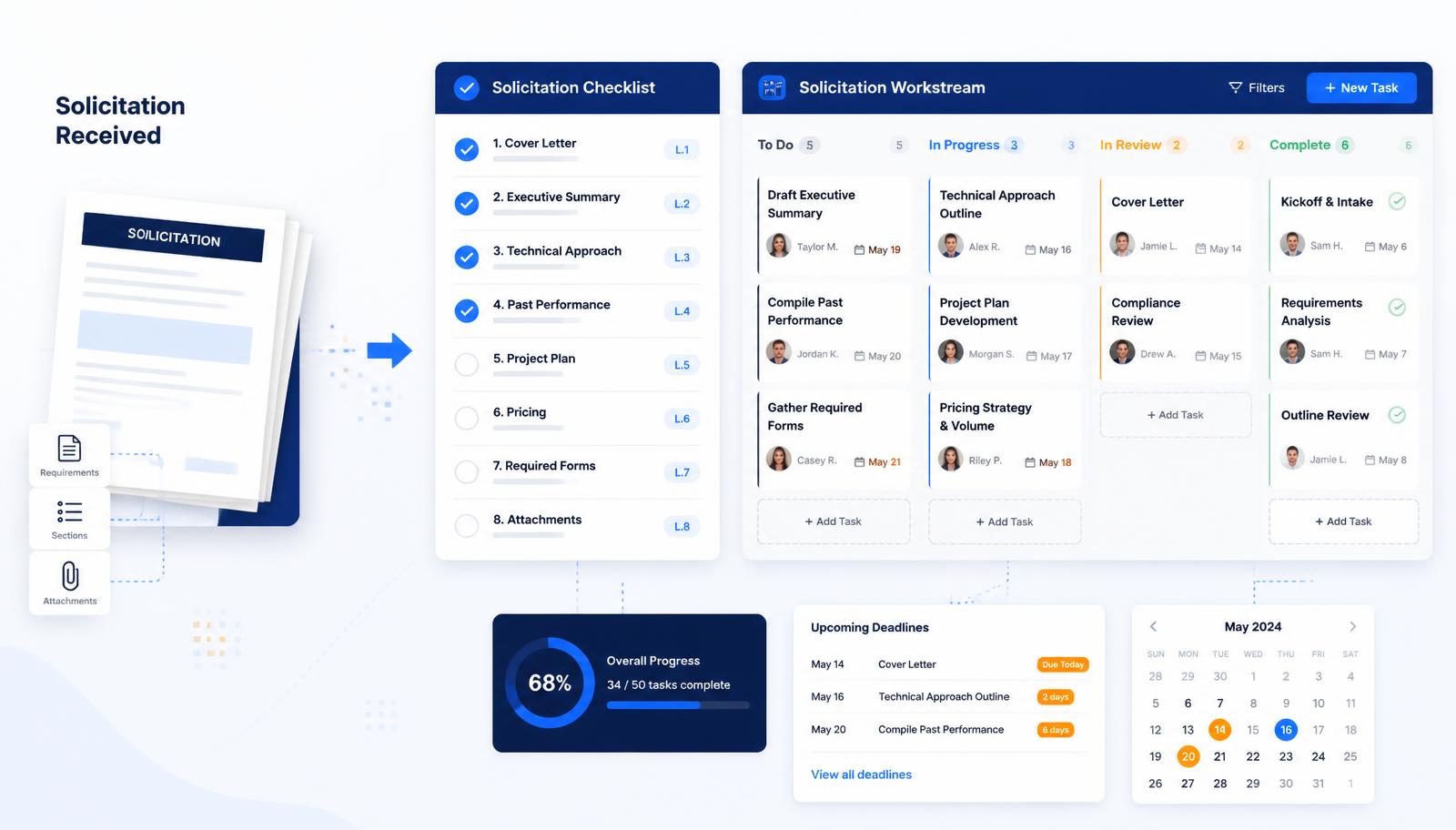
How to Bid on Government Contracts: A Practical Guide for Small Businesses
Most losing bids fail on completeness, not price. A ten-step process for reading a solicitation, making a bid/no-bid call, and submitting a compliant response on time.
11 min read
Read Article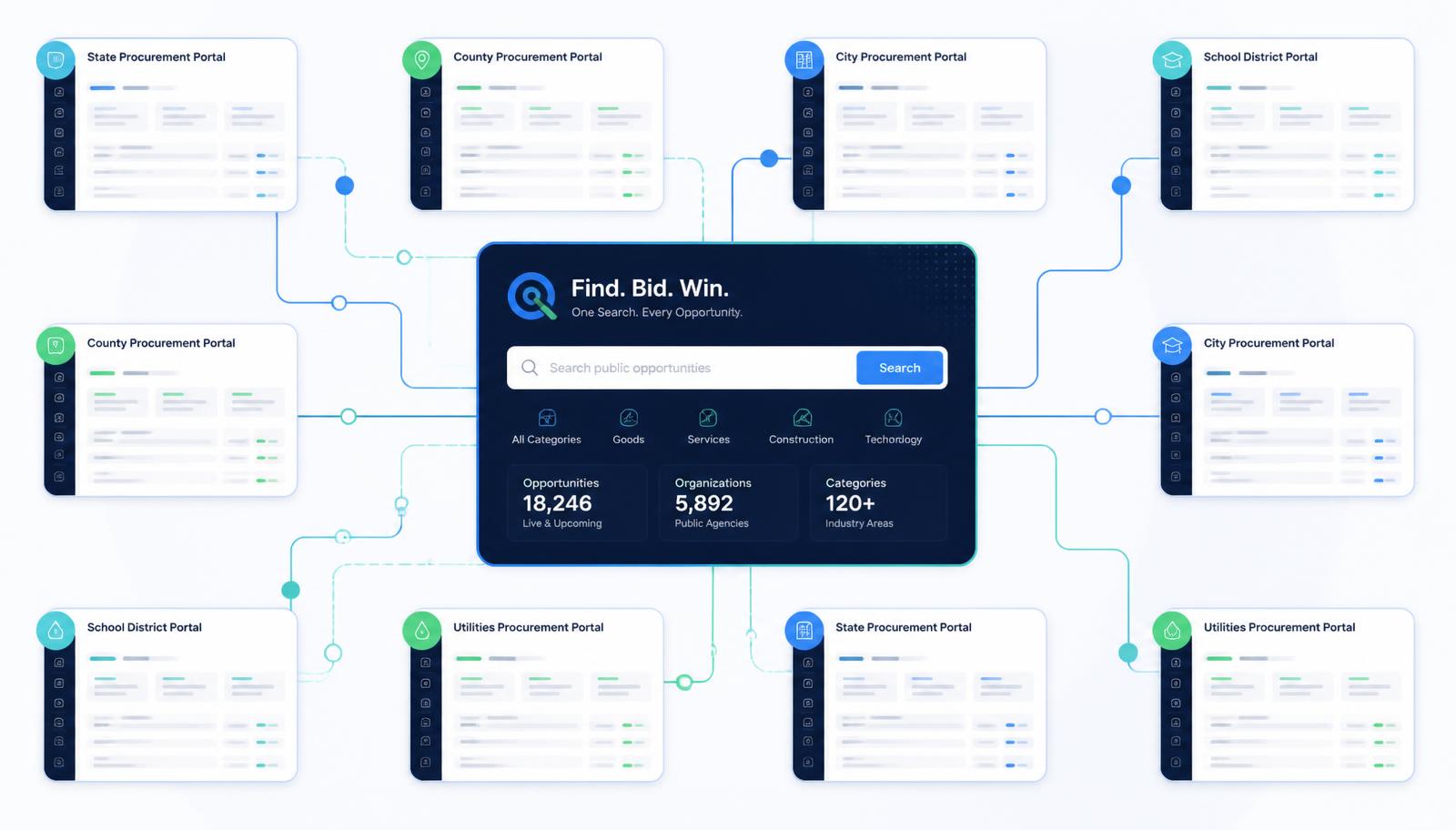
SAM.gov Isn't the Only Place to Find Government Contracts
SAM.gov is the official source for federal opportunities. State, county, city, school district, and public authority contracts are published somewhere else entirely — here is where.
9 min read
Read Article